
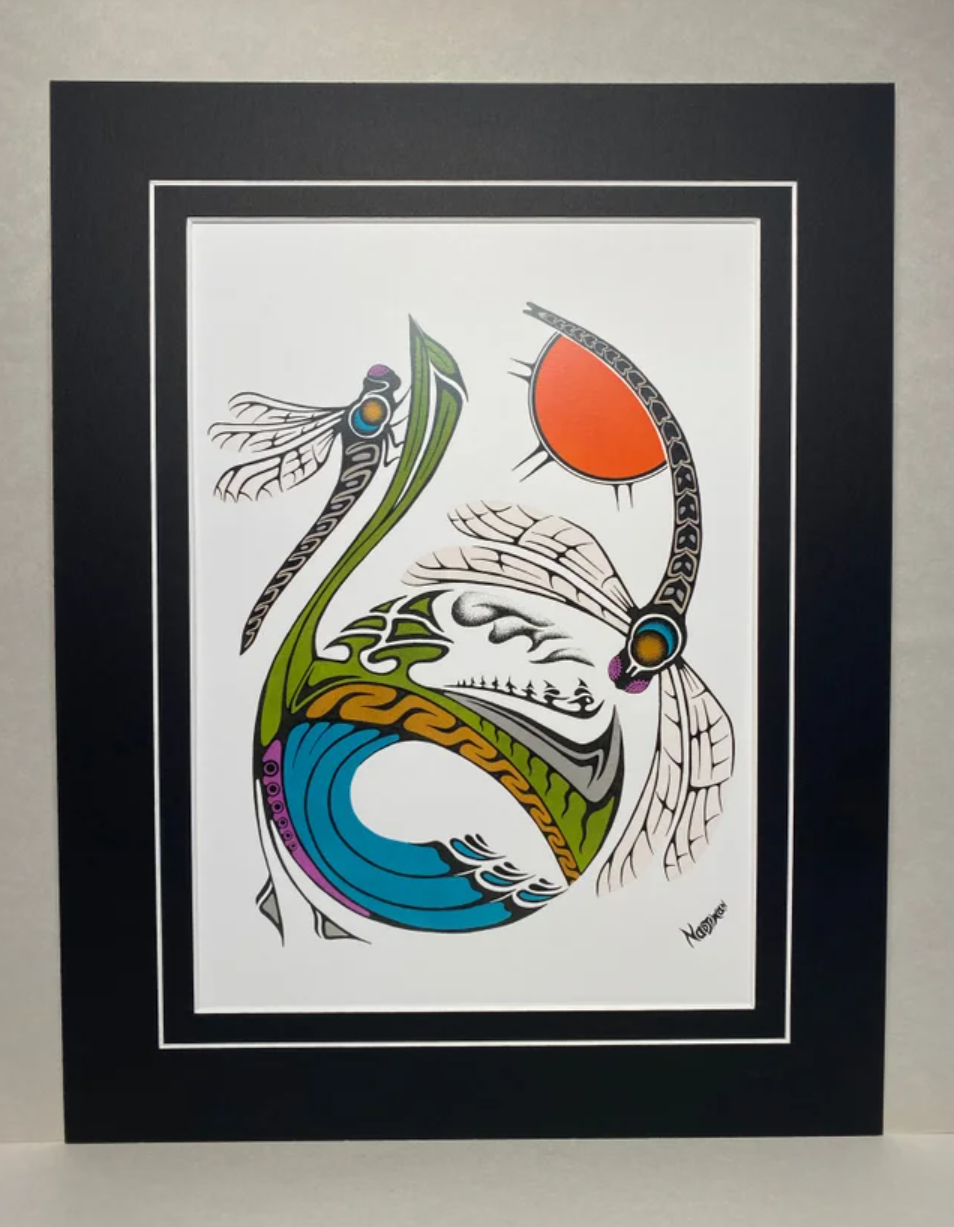
11″ x 14″ Unframed Matted Decorative
(Fits standard 11″ x 14″ frame). Each item is packaged in an acid-free, resealable clear bag.
Dragonfly, or Oboodashkwaanishiinh to the Anishinaabek, lives its life among two realms. Born of water, as you can see represented in the artwork by the magenta-coloured eggs to the lower left, it spends most of its life there in nymph form after hatching. Following its final moult, it lives out its short adult life in the earthly domains of land and air, returning to the water to lay its eggs; thus, ensuring the next generation. The continuance of the life-force throughout their life cycle — from eggs to nymphs and finally to mature dragonflies — is rendered by way of the magenta-coloured eyes. Also depicting their dual natures are the dominant colours of their two worlds reflected in their bodies — the blue of the aquatic realm and the sandy brown of the land.
As always, it is wise to learn the lessons provided by our fellow creatures. In this case, we can all be reminded of the importance of “dwelling in two worlds” as we undertake the urgent work necessary to understand and protect our fragile ecosystems. Our “two-world task” is to acquire what has come to be known as two-eyed seeing; the ability to view and study the natural world with both traditional Indigenous knowledge (one eye) and the Western sciences (the other eye). This fusion of cultural and scientific intelligences will create an enhanced approach to help ensure our success in addressing the serious environmental challenges we are faced with today. Indeed, this piece and its story were inspired by the work of Potawatomi knowledge keeper and scientist, Robin Wall Kimmerer, and her ground-breaking book Braiding Sweetgrass: Indigenous Wisdom, Scientific Knowledge, and the Teachings of Plants.
Mark Nadjiwan is a self-taught artist whose chosen medium is pen and ink, working in archival acrylic inks on acid and lignen-free illustration boards. His unique style is a fusion of several artistic traditions, and includes the Indigenous inspired designs of both the Woodland and West Coast schools, as well as non-Indigenous approaches such as realism. Mark’s work can be found in numerous venues across Canada as well as private collections in Canada, the United States and Europe. In November of 2022, he was inducted as a Fellow of the Royal Canadian Geographical Society. His First Nation roots are grounded in the Georgian Bay and Lake Superior Treaty regions, and he is a citizen/member of Neyaashiinigmiing Unceded First Nation. Mark lives on the traditional and current territory of the Saugeen Ojibway Nation (SON), in Treaty 72, along with his wife, Patricia Gray, who is also an artist, working in acrylic mediums.

Reviews
There are no reviews yet.